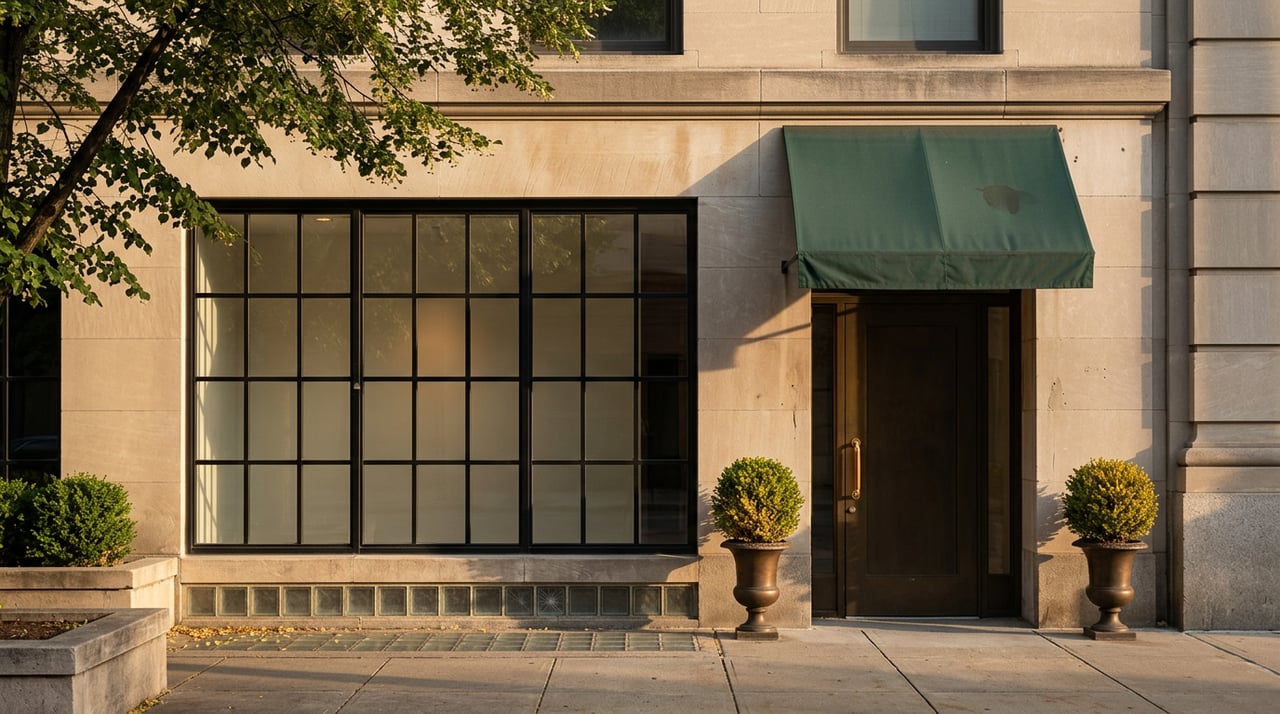
The Real Story Behind All That Construction on Oak Street This Summer
August 20, 2026
August 20, 2026
"When you walk down Oak Street, everyone knows Razny," Ingrid Razny, the jewelry company's president, said back in February when her family completed the purchase of 109 East Oak Street. It's a line that could apply to half the storefronts on this block right now, and it points to something residents walking their dogs past the scaffolding this August have probably already sensed without being able to name it. The construction fencing, the permit notices taped to old glass doors, the sudden appearance of a rooftop restaurant where there used to be office space: none of it is random. It's the visible result of a handful of families deciding to finally build on land they've owned for decades, while at least one outside investor heads for the exit.
If you've noticed Oak Street looking like a work zone lately, you're not imagining it. Three separate projects, on three different blocks, are reshaping the same three-hundred-foot stretch between Michigan Avenue and Rush Street at the same time. What's easy to miss, unless you're paying close attention to who owns what, is that the story isn't really about new construction. It's about who's finally pulling the trigger on buildings they've controlled for a generation, and who's deciding it's time to sell.
The most visible project sits at 67 East Oak Street, on the block between Michigan Avenue and Rush Street that anchors the Gold Coast's luxury shopping strip. Chicago issued a full building permit on August 13 for an $8.1 million redevelopment there, clearing a five-story multi-tenant building for demolition and replacement with a two-story flagship designed for a single tenant. Myefski Architects designed it, LG Group is the general contractor, and reports point to Van Cleef & Arpels as the likely occupant once it's done. The building's retail spaces had been home to custom haberdashery Ike Behar and tabletop boutique The Perfect Setting before the demolition permit came through.
Down the block, Razny Jewelers has spent the past two years assembling its own footprint. The family bought 107 East Oak Street in March 2024, then completed the purchase of the adjoining 109 East Oak Street this past February, giving them ownership of both addresses. The 109 East Oak building is a 7,500-square-foot, three-story space that already serves as Razny's Rolex and Patek Philippe showroom, and the company has secured approvals to connect the two properties into a four-story flagship anchored by a dedicated two-story Rolex showroom.
Then there's the building at 30 East Oak Street, home to Prada's Chicago flagship, which its New York-based owner put up for sale in June with an expected price around $30 million, according to Crain's. The 11,000-square-foot space is flanked by a salon, athletic brand Vuori, and outdoor retailer Arc'teryx, and it's one of several Gold Coast retail properties testing the sale market this year alongside a converted Rush Street bank building leased to Skims and Water Tower Place, where MetLife is spending $170 million to repurpose the vertical mall.
Here's how the ownership pattern breaks down across the block's most visible projects:
| Address | Who owns it | Since | What's happening now |
|---|---|---|---|
| 67 E. Oak St. | Distelheim family (67 E. Oak Street Partners LLC) | 1960s | Demolition permit issued, single-tenant flagship planned |
| 107–109 E. Oak St. | Razny family | 2024 and Feb. 2026 | Connecting into a four-story flagship with dedicated Rolex showroom |
| 30 E. Oak St. | J. Safra Real Estate (New York) | Not disclosed | Listed for sale, expected around $30 million |
The Distelheim connection to 67 East Oak goes back further than most people walking past it would guess. City filing records list the property under the management of Ellen Distelheim, whose father, Dr. Irving Distelheim, opened a gallery at that address in the 1960s. In 1968, the building briefly served as Hubert Humphrey's Chicago campaign headquarters before a renovation added a modern glass facade and turned it into the boutique shops and art galleries that included Distelheim Galleries, a name tied to the property across decades of Oak Street's evolution into a luxury corridor. Now, more than half a century later, the same family that watched Oak Street become what it is has decided the building's next chapter should be single-tenant and purpose-built, not another round of leasing out ground-floor space to whoever wants a piece of the address.
Razny's story runs in parallel. The company has operated in Chicago for 75 years, and the family purchased the building at 109 East Oak after first assuming the lease there in 2016. The property itself has stayed under the same ownership since the 1930s, when it was originally occupied by a jeweler and watchmaker, a detail that makes Razny's purchase feel less like an acquisition and more like a homecoming. Stan Razny, the company's CEO, called it the next chapter in three generations of family leadership. Financing for the deal came through Amalgamated Bank Chicago, with Field and Goldberg and Level One Advisory Group handling legal and advisory work.
Both projects share the same underlying decision: instead of leasing space and letting someone else capture the upside of Oak Street's continued pull, the families who've held these addresses for decades are building for themselves.
Contrast that with 30 East Oak. J. Safra Real Estate, based in New York, has owned the Prada building without the multi-generational Chicago roots that define the Distelheim and Razny stories, and the decision to sell now, with Newmark handling the search for a buyer, reads as a straightforward cash-out on a strong asset rather than a bet on the street's next decade. It's not an isolated move. L3 Capital hired CBRE in April to sell 1000 North Rush Street, the converted bank building leased to Kim Kardashian's Skims brand, while also picking up retail space in the base of the Palmolive Building that includes a Louis Vuitton store. Oak Street itself has largely avoided the vacancy problems affecting other Chicago retail corridors, which is precisely what makes it an attractive moment to sell rather than a sign of trouble.
Not every new arrival on or near Oak Street is buying the building. Some are testing the water first, and the mix says as much about the street's pull as the construction does.
That last one is worth sitting with for a second. A pop-up is the opposite move from what the Distelheims and the Raznys are doing. It's a way to test whether an address earns its rent before committing capital to it. The fact that a fast-growing furniture brand chose Oak Street's immediate orbit for that test, rather than River North or the Mag Mile, tells you the street's reputation still does the work of attracting new retail concepts even before anyone's sure they'll stay.
None of this changes the sidewalk you walk on your way to the gym or the dog park, at least not yet. But it does change what the scaffolding means. A five-story building coming down at 67 East Oak isn't decline, it's a family that's owned the address since the Kennedy administration deciding it's finally time to build the thing they've wanted. A jeweler connecting two buildings into one flagship isn't overreach, it's three generations catching up to what the block has become. And a New York firm listing its Prada building for sale isn't a warning sign, it's simply what a good return looks like when someone else is ready to take the next thirty years.
The street looks the same as it always has from a distance. Up close, it's being rebuilt by the people who've had the longest view of it.
If you're curious how any of this fits into the bigger picture for a home or property near Chicago's western suburbs or the Gold Coast corridor, Lisa Zaklan is always happy to talk through what's actually happening on the ground, no obligation required.

With over 25 years of sales & marketing knowledge and experience, Lisa has built her reputation on integrity & service and believes in using her experience in contract negotiations, sales and marketing to your advantage.